
Double Decker Root Bridge Trek: Steps, Time and Tips
Double decker root bridge trek from Tyrna to Nongriat: about 3,500 steps, 2 to 3 hours down, route, Rainbow Falls, guides, fees, stays and the best months.
Shillong Trip Travel Desk · Updated · 9 min read
 Chiranjeeb Baul · Commons · CC BY-SA 4.0
The double decker root bridge trek starts at Tyrna, 30 minutes from Sohra, and drops roughly 700 m down about 3,500 steps to Nongriat. Allow 2 to 3 hours down and 2.5 to 4 hours back up, or 6 to 8 hours in all. Go October to March, start by 9 am and hire a registered local guide.
Key takeaways
- About 3,500 steps and roughly 700 m of descent separate Tyrna from the double decker bridge at Nongriat
- The return day trip takes 6 to 8 hours; the climb back up is the hard part, not the way down
- Staying a night in Nongriat lets you add Rainbow Falls and avoid climbing out in the afternoon heat
- October to March is the easiest window; from mid-June to August the steps are slippery and streams rise
- East Khasi Hills has required registered local guides on treks since 2025; check current status before you travel
- Carry cash in small notes for village entry fees, water and snacks; there are no ATMs below Tyrna
On this page 13 sections
- The trek at a glance
- Where the trek starts
- The route, step by step
- What you are walking to
- Staying safe on the trail
- How long it really takes
- Rainbow Falls: worth the extra walk
- Staying overnight in Nongriat
- Guides, fees and rules
- Best time to do the trek
- What to wear and pack
- Easier alternatives if the steps are too much
- How we'd plan it
- FAQs
Every guest who has done this trek tells us the same thing: going down is easy for the first thousand steps and hard on the knees after that, and climbing back up is the longest two hours of their trip. It is also the walk they talk about most once they are home.
The Nongriat double decker bridge is two living bridges stacked one above the other, grown from the roots of rubber fig trees over a stream deep in the gorge below Sohra. There is no road to it. You walk. Below is the route step by step, how long it takes, what it costs and how to do it without ruining your knees or your afternoon.
The trek at a glance
| Detail | What to expect |
|---|---|
| Start | Tyrna village, about 30 minutes by road from Sohra |
| End | Nongriat village and the double decker bridge |
| Steps | About 3,500, mostly concrete |
| Height lost | Roughly 700 m |
| Distance | About 3 km each way |
| Time down | 2 to 3 hours |
| Time up | 2.5 to 4 hours |
| Full day trip | 6 to 8 hours with time at the bridge |
| Add-on | Rainbow Falls, 1 to 1.5 hours beyond the bridge |
| Best months | October to March |
| Difficulty | Moderate: easy path, hard on legs |
Where the trek starts
Tyrna sits on a ridge below Sohra in East Khasi Hills, about 30 minutes by road from Sohra town and roughly 2 hours from Shillong. The road ends at a small parking area with a few shops selling water, snacks and walking sticks. This is where you meet your guide and pay any village fee collected at the top.
Most guests base themselves in Sohra the night before. Starting from Shillong the same morning is possible, but it puts you on the steps later in the day and makes the climb out tighter. Our where to stay in Cherrapunji guide lists the options near Tyrna.
Without a car, take a shared taxi from Shillong's Bara Bazar to Sohra, about 1.5 to 2 hours, then a local taxi from Sohra to Tyrna. Arrange the return taxi before you start down; phone signal at the bottom is weak and taxis do not wait at Tyrna on spec in the evening. With your own car, the parking area at Tyrna is small and fills by 10 am on winter weekends.
The route, step by step
Tyrna to Nongthymmai
The first section is a long, steady staircase through areca nut and betel leaf groves, with village houses, small shops and occasional viewpoints. The steps are concrete and uneven in height, which is what tires your thighs. After about an hour you reach Nongthymmai, a small village with a single-span root bridge a short detour off the main path.
The steel-wire bridges over the Umshiang
Below Nongthymmai the path reaches the stream and crosses it on two long steel-wire suspension bridges. They sway as you walk, and in the monsoon the water beneath is loud and fast. Cross one person or a few people at a time, hold both side cables and do not stop in the middle for photos if others are waiting.
Up to Nongriat
After the second bridge the path climbs again, a few hundred steps, into Nongriat village. It is the only real uphill on the way down and it surprises people. The double decker bridge is a short walk through the village, where you pay the entry fee.
At the bridge
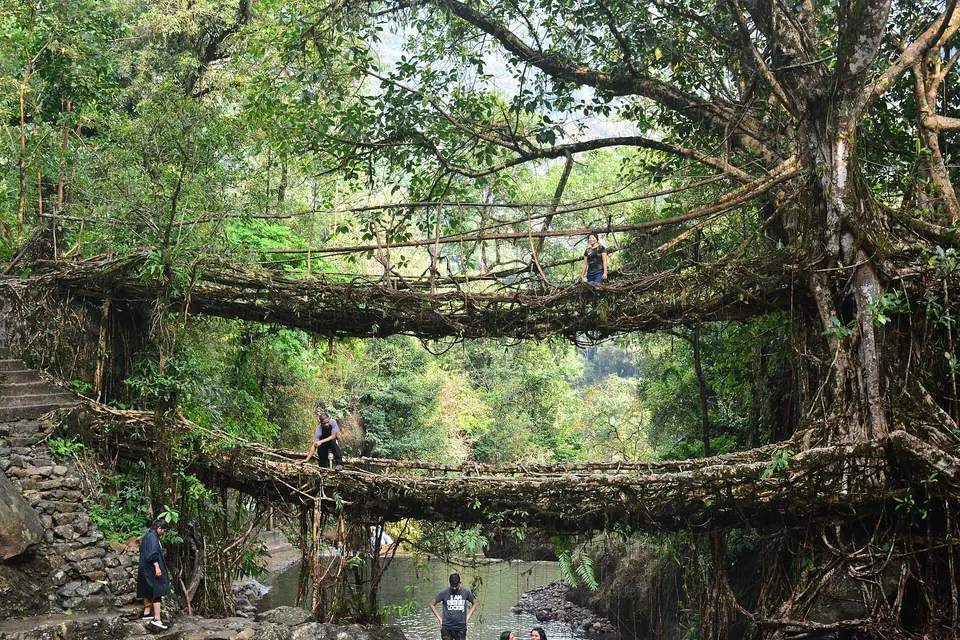
The bridge itself is two levels of living roots spanning the stream, with a natural pool below and boulders to sit on. Allow an hour here. From October to March the water is clear and blue and the pools are swimmable if you do not mind cold water. Treat the bridge with care: walk only where locals walk, and do not climb on the root structures to pose.
What you are walking to
The double decker bridge is often described as about 200 years old, though nobody can date it precisely. Like all Khasi living bridges, it was grown rather than built: villagers guided the aerial roots of rubber fig trees (Ficus elastica) across the stream, often along bamboo or areca frames, and waited years for them to thicken and fuse. The lower deck came first; the upper deck was trained later, which is why it looks a little lighter.
The bridges are still in daily use and still maintained by the village. Researchers geo-located 75 living bridges across the region in 2017, and in 2022 the living root bridge cultural landscapes of Meghalaya were placed on UNESCO's tentative list of World Heritage Sites. Walking to Nongriat is visiting a working village, not a monument, and the small fees you pay go into its upkeep.
Staying safe on the trail
The trek is safe for most people who respect it. The common problems are simple ones.
- Knees on the descent. Take short steps, use poles, and stop for a minute every 300 to 400 steps.
- Dehydration on the climb. Drink before you feel thirsty, especially from March to May.
- Slips on wet steps. Moss makes the lower sections slick after rain. Walk on the dry edge of each step.
- Crowding on the wire bridges. Wait your turn; too many people on a swaying bridge is uncomfortable for everyone.
- Swimming. Pools look calm but can be deep and cold. Do not swim after heavy rain or alone.
- Late starts. The trekkers still climbing at dusk are almost always the ones who started down after 11 am.
If anyone in your group feels unwell below Nongriat, stop and rest. Village homestays can help, and your guide knows how to get word up to Tyrna.
How long it really takes
Time depends more on your knees and lungs than on distance. These are the ranges we see among our guests.
| Walker | Down to Nongriat | Up to Tyrna | Full day trip |
|---|---|---|---|
| Fit and regular walker | About 1.5 to 2 hours | About 2 to 2.5 hours | About 6 hours |
| Average fitness | 2 to 3 hours | 2.5 to 3.5 hours | 7 to 8 hours |
| Slow walker or weak knees | 3 hours or more | 4 hours or more | Stay overnight instead |
The climb back is where most people run over their estimate. Start down by 9 am, leave the bridge by 1 pm on a day trip, and you will be at Tyrna with daylight to spare. In December and January, sunset is at about 4.45 pm.
Rainbow Falls: worth the extra walk
Beyond the double decker bridge, a rougher trail continues for 1 to 1.5 hours to Rainbow Falls, passing the smaller Mawsaw root bridge. The trail has more climbs and descents than the main path and some rocky sections. At the end, a waterfall drops into a pool of intense blue water, and on sunny mornings a rainbow forms in the spray, which is how it got its name.
Adding Rainbow Falls on a day trip is possible only for fast, fit walkers who start by 7 am. For everyone else, it needs a night in Nongriat. That is the main reason our five-night Living Root Bridges Trek, from INR 18,500 per person, spends a night in the village and walks to Rainbow Falls the next morning before climbing out.
Staying overnight in Nongriat
Nongriat has several simple homestays and guesthouses run by village families. Expect:
- Basic rooms, often with shared bathrooms
- Home-cooked rice, dal, vegetables and sometimes eggs or chicken
- Limited and unreliable electricity, and weak or no phone signal
- Early nights and very quiet mornings
The payoff is the bridge in the late afternoon and early morning, when day hikers have gone, and a cooler, easier climb out the next day. Book ahead in November, December and around long weekends; rooms are few.
Guides, fees and rules
Guides. The path is clear and signposted, and for years many visitors walked it alone. Since mid-2025, East Khasi Hills district has required tourists on treks to go with registered local guides. Guides are available at Tyrna and through homestays and operators. Rules and guide fees can change, so check current status before you travel.
Fees. Nongriat charges a small entry fee at the bridge, and there may be separate camera fees and a fee for Rainbow Falls. Amounts are modest, typically under INR 100 per person, and paid in cash.
Cash. There are no ATMs below Tyrna and card payments are rare. We suggest about INR 2,000 in small notes per group for fees, water, snacks, tips and porters.
Porters. Some villagers carry bags up for a fee. It is worth it if you are staying overnight with more than a day pack.
Rules. No plastic left behind, no loud music, no alcohol in the village, and ask before photographing people. Swim only where locals swim.
Best time to do the trek
| Months | Conditions | Our view |
|---|---|---|
| October to November | Streams still full, steps drying, pools clear by November | Very good |
| December to February | Dry, cool, clear water, short days | Best |
| March | Warm, dry, good light | Very good |
| April to May | Hot and humid, pre-monsoon storms in afternoons | Go early |
| June to September | Heavy rain, slippery steps, fast streams, leeches | Experienced and careful walkers only |
The monsoon version has its own appeal: waterfalls pour off every cliff and the forest is at its greenest. But the steel-wire bridges over a swollen stream and wet, mossy steps are not what we would choose for a first trek. Our best time to visit Meghalaya guide covers the wider weather picture.
What to wear and pack
- Trail shoes with good grip. Not new boots, not flip-flops. Sandals with straps work in dry months if you are used to them.
- Trekking poles if you have any knee trouble. They make the descent far easier.
- Two litres of water per person, plus snacks. Water is sold in the villages but costs more the further down you go.
- A light rain jacket in any month.
- Swimwear and a small towel if you plan to swim at the pools.
- A headtorch in case the climb runs late.
- Leech socks or salt from May to September.
- Cash in small notes.
Our packing guide for the Northeast has a fuller list.
Easier alternatives if the steps are too much
Not everyone should do 3,500 steps, and that is fine. Meghalaya has other root bridges you can reach with far less effort.
- Riwai root bridge near Mawlynnong: a single living bridge about 10 to 15 minutes' walk from the road. Easy for children and seniors.
- Root bridges around Sohra: several single bridges sit closer to roads than Nongriat; ask your guide which are open and how far to walk.
Our living root bridges explained guide covers how the bridges are grown, where the others are and why the Khasi and Jaintia bridge landscapes are on UNESCO's tentative list.
How we'd plan it
We build the trek around one rule: never climb out of Nongriat in a hurry.
- Night 1 in Sohra. Arrive from Shillong or Guwahati, see Nohkalikai Falls in the afternoon if the cloud allows.
- Day 2: Tyrna to Nongriat. Start down by 9 am with your guide, reach Nongriat by noon, spend the afternoon at the bridge and pools, and sleep in the village.
- Day 3: Rainbow Falls and the climb out. Walk to Rainbow Falls early, return for lunch, and climb to Tyrna by mid-afternoon. Sleep in Sohra.
- Day 4: Rest your legs. An easy day at Wei Sawdong Falls and the Sohra viewpoints.
Short on time? Our six-night Complete Meghalaya trip, from INR 23,500 per person, does the trek as a full day from Sohra. Budget travellers can join the trek on our Northeast Backpacker Route, and those who want more adventure can pair caves and canyons on the Caves, Canyons and Camping trip. Our Cherrapunji travel guide covers the rest of Sohra.
Tell us your fitness and dates on the contact page and we will suggest a day trip or an overnight.