
Living Root Bridges in Meghalaya: How They Grow
How Meghalaya's living root bridges grow from rubber fig roots, which ones you can walk to, how hard each trek is, and their UNESCO tentative-list status.
Shillong Trip Travel Desk · Updated · 9 min read
 Chiranjeeb Baul · Commons · CC BY-SA 4.0
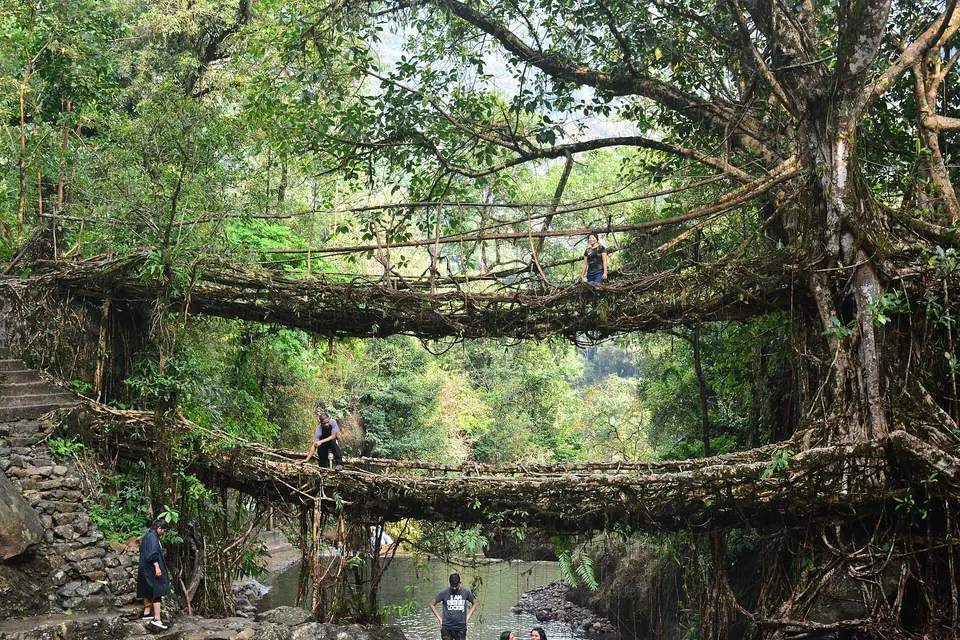
Meghalaya's living root bridges are footbridges grown, not built: Khasi and Jaintia villagers guide the aerial roots of rubber fig trees across streams until they fuse into a load-bearing span. It takes 10 to 15 years or more. The best known is the double decker at Nongriat, about 3,000 steps below Tyrna near Sohra.
Key takeaways
- Root bridges are trained from the aerial roots of the rubber fig (Ficus elastica), which fuse together and thicken as the tree grows
- A new bridge takes roughly 10 to 15 years to carry people and can keep strengthening for generations
- Around 70 to 100 bridges are known across dozens of villages in East Khasi Hills and West Jaintia Hills
- Jingkieng Jri, the living root bridge cultural landscapes, went on India's UNESCO World Heritage tentative list in 2022; tentative is not the same as inscribed
- The easiest bridge to see is Riwai near Mawlynnong, a few minutes' walk; the Nongriat double decker needs a steep descent of about 3,000 steps
- October to March is the best trekking window; monsoon brings full streams but slippery steps
On this page 12 sections
- What a root bridge is made of
- How villagers grow one
- Why the Khasi hills grow bridges
- Three myths worth clearing up
- Bridges and village life
- The UNESCO status, explained
- Bridges you can actually visit
- The Nongriat double decker in detail
- Riwai and the easy option
- When to go
- How to visit without harming them
- How we'd plan it
- FAQs
A living root bridge is the only piece of infrastructure we know of that gets stronger the longer you leave it alone. That single fact explains why Khasi villages have grown them for generations, and why travellers walk thousands of steps to stand on one.
This guide covers how the bridges work, where to see them, how hard each walk is, and what their UNESCO status actually means.
What a root bridge is made of
Every living root bridge in Meghalaya starts with one species: the rubber fig, Ficus elastica. It is the same plant sold as a houseplant in cities, but in the wet forests of the Khasi and Jaintia hills it grows into a large tree that drops aerial roots from its trunk and branches.
Those aerial roots are the building material. They are soft and pliable when young, they keep growing towards soil and moisture, and, importantly, they fuse where they touch. Botanists call this inosculation. Two roots pressed together for long enough grow into one, and a mesh of crossing roots becomes a single rigid lattice.
The trees also like where the bridges are needed. Rubber figs root happily on rocky riverbanks and hold on through floods that would wash away a timber post.
How villagers grow one
There is no single method. Builders in different villages use what works for their stream. The common steps look like this:
- Choose or plant a fig on one bank, sometimes on both.
- Guide young roots across using a temporary frame. The traditional guide is the hollowed trunk of an areca (betel nut) palm split lengthwise and laid over the stream; roots grow along it and the decaying trunk feeds them. Bamboo scaffolds and, more recently, steel cables are also used.
- Anchor the roots on the far bank, where they enter the soil and start drawing nutrients.
- Weave, tie and add more roots over the years to form handrails, side walls and a deck.
- Fill the deck with stones and soil so people walk on a level surface while the roots below keep thickening.
A bridge usually becomes safe to walk on after roughly 10 to 15 years, and longer spans take more. After that, maintenance is steady but light: replacing loose deck stones, redirecting new roots, and trimming growth that pulls the span out of shape.
| Stage | Typical timing | What is happening |
|---|---|---|
| Planting and guiding | Year 0 to 3 | Fig established, first roots guided along areca trunks or bamboo |
| Anchoring | Year 3 to 8 | Roots reach the far bank and root into soil |
| First crossings | About year 10 to 15 | Roots fused enough to carry a person; deck filled with stones |
| Mature bridge | Decades onward | Roots thicken, spans can carry many people at once |
| Renewal | Ongoing | New roots added, damaged sections rerouted by the community |
These are indicative ranges we have heard from builders and guides, not fixed rules. A healthy tree on a narrow stream can move faster; a wide span can take a generation.
Why the Khasi hills grow bridges
The southern slopes of the Khasi Hills catch the full monsoon off the Bay of Bengal. Sohra and neighbouring Mawsynram are among the wettest inhabited places on earth, with annual rainfall measured in metres rather than centimetres. In that climate, cut timber rots within a few seasons and flash floods take out anything rigid.
A living bridge solves both problems. It does not rot because it is alive, and its roots flex with floodwater rather than snapping. For villages in deep valleys, such as Nongriat, these bridges were the difference between reaching the market and being cut off for the rains.
Researchers, including teams working on "living architecture" in Germany, have studied the bridges as examples of structures that repair and strengthen themselves. The larger point is simpler: the knowledge is local, oral and still in use.
Three myths worth clearing up
A few claims turn up again and again on social media. Here is what we tell travellers.
"They are 500 years old." Some may be old, but there is no reliable dating for most bridges. The tradition is oral, and villagers talk about who started or restored a bridge, not a founding year. The often-quoted figure for the Nongriat double decker is around 200 years, and even that is an estimate.
"They are a dying art." Not quite. Several villages have started new bridges in recent decades, and local groups and young builders have worked to document and restore older ones. The bigger risk is not neglect but overuse at a handful of famous spans while bridges in less-known villages see few visitors.
"There is only one double decker." The Umshiang bridge at Nongriat is the famous one, but multi-level and ladder-like root structures exist in other villages too. What makes Nongriat special is the combination of the stacked spans, the village setting and the swimming pools downstream.
Bridges and village life
It helps to remember that these are working bridges first and attractions second. Children walk across them to school, farmers carry betel nut, bay leaf and broom grass over them to the road, and families maintain the section nearest their land. In Nongriat, where there is still no motorable road, almost everything, from rice sacks to gas cylinders, reaches the village on someone's back via the same steps you walk.
That shapes how a visit feels. You will pass homes, small shops selling tea, biscuits and cold drinks, and signs asking visitors to keep noise down. The entry fees you pay go to the village, and the homestays are family-run. Spending a night, buying a meal and hiring a local guide for Rainbow Falls puts money directly into the community that keeps the bridges alive.
The UNESCO status, explained
This is where many articles get it wrong.
In 2022, India added "Jingkieng Jri: Living Root Bridge Cultural Landscapes" to its UNESCO World Heritage tentative list. The listing covers the living root bridge tradition across about 70 villages in East Khasi Hills and West Jaintia Hills, not only the famous double decker.
A tentative list is a country's inventory of sites it intends to nominate. It is a necessary first step, but it is not inscription. A full nomination still has to be prepared, evaluated and approved. Until the World Heritage Committee inscribes the site, the bridges are not a World Heritage Site, and anyone who tells you otherwise is overstating it. Check current status before you travel if you are writing about it or planning around it.
Bridges you can actually visit
There are many more bridges than most itineraries include. These are the ones travellers reach most often.
| Bridge | Nearest base | Walk | Effort | Time from Shillong |
|---|---|---|---|---|
| Umshiang double decker, Nongriat | Tyrna, near Sohra | 3,000 to 3,500 steps down and back up | Hard | About 2.5 hours to Tyrna |
| Ritymmen single bridge | Tyrna trail, before Nongriat | Short detour off the same trail | Moderate to hard | Same as above |
| Riwai single bridge | Riwai, beside Mawlynnong | 10 to 20 minutes each way | Easy | About 2.5 to 3 hours |
| Mawsaw bridge | Short walk beyond Nongriat | 30 to 45 minutes from the double decker | Moderate | Combine with a Nongriat night |
| Rangthylliang, one of the longest | Pynursla area, south-east of Shillong | Village trail, varies | Moderate | Plan a full day |
Walking times vary with fitness and weather. Village entry and parking fees are small and paid in cash at the gate.
The Nongriat double decker in detail
The double decker root bridge at Nongriat is the one on every postcard: two spans stacked one above the other across the Umshiang stream, often estimated at around 200 years old. A third, higher level has been in training in recent years.
The walk starts at Tyrna, about 30 minutes by road below Sohra. From there, concrete steps drop steeply through village gardens, past areca and jackfruit trees, and cross two steel suspension bridges over the river. Most people take 2 to 3 hours down, stopping for photographs, and 2.5 to 3.5 hours back up.
If you have the legs, stay a night in Nongriat's simple homestays. That lets you walk another hour or so to Rainbow Falls, swim in the natural pools in the dry season and climb out the next morning while it is cool. Our double decker root bridge trek guide has the step-by-step route, packing list and homestay notes.
Riwai and the easy option
Not everyone can manage 3,000 steps each way. The single root bridge at Riwai, next to Mawlynnong, is the answer. A short, stepped path leads down through forest to a compact bridge over a clear stream. Children and seniors manage it comfortably, and it slots into a day that includes Mawlynnong village and the Umngot river at Dawki.
Our Umngot river and Mawlynnong trip includes Riwai without any hard trekking, and the Mawlynnong guide covers the village walk and the Sky View bamboo platform.
When to go
| Months | Trail conditions | What you see |
|---|---|---|
| October to November | Dry steps, clear pools | Green valleys, good light, comfortable climb |
| December to February | Dry and cool | Clearest water, best for swimming at Nongriat |
| March to May | Warmer, some storms from April | Fewer crowds midweek, hot climb by midday |
| June to September | Wet, slippery, leeches possible | Full streams and falls, thick moss; trek with a guide |
The monsoon is when the bridges look most alive, and also when they are hardest to reach. If you go in July or August, wear shoes with real grip, start early and accept that the stream may be too high for swimming. Our best time to visit Meghalaya guide explains the monsoon trade-offs in more detail.
How to visit without harming them
The villages own these bridges and depend on them. A few habits help:
- Stay on the deck. Do not climb the handrail roots or hang off side roots for photographs.
- Leave the moss. It protects the roots from drying out.
- Respect crowd limits. Some villages restrict how many people stand on a span at once. Wait your turn.
- Carry plastic out. Nongriat has no road, so everything that goes down has to be carried up.
- Pay entry fees willingly. They fund maintenance and village work.
- Ask before photographing people. Homes and gardens line the trail.
How we'd plan it
For a first-timer with average fitness, we build the bridges into a Sohra stay rather than a rushed day trip from Shillong. Two nights in Sohra lets you do Tyrna to Nongriat on one full day, with the rest of the time for falls and caves. Our where to stay in Cherrapunji guide lists areas close to the trailhead.
Here is how we would match trips to people:
- Fit travellers who want the full experience: the five-night living root bridges trek includes a night in Nongriat, Rainbow Falls and Wei Sawdong falls.
- Families and mixed-age groups: the four-night Shillong, Cherrapunji, Dawki and Mawlynnong trip includes a night in Mawlynnong, a short walk from the easy Riwai bridge.
- One week, photographers or keen walkers: the six-night complete Meghalaya route gives Nongriat a full trek day, then adds a Mawlynnong night, Dawki and Krang Suri falls.
- Budget backpackers on a longer loop: the nine-night Northeast backpacker route adds Kaziranga and Majuli.
On the trek day itself, we have drivers drop guests at Tyrna by 7.30 am. That puts you at the double decker before the late-morning groups arrive, gives you time at the pools, and has you climbing back in the cooler afternoon rather than the midday heat. If anyone in the group has knee trouble, we suggest bringing trekking poles and hiring a local porter for the day bag. For those staying overnight in Nongriat, pack light: a small backpack, a torch, a change of clothes and cash, since there are no ATMs below Tyrna.
Start by deciding how many steps your group can manage, then pick the bridge, then build the trip around it.
To plan a root bridge trip with the right pace for your group, message us on our contact page.