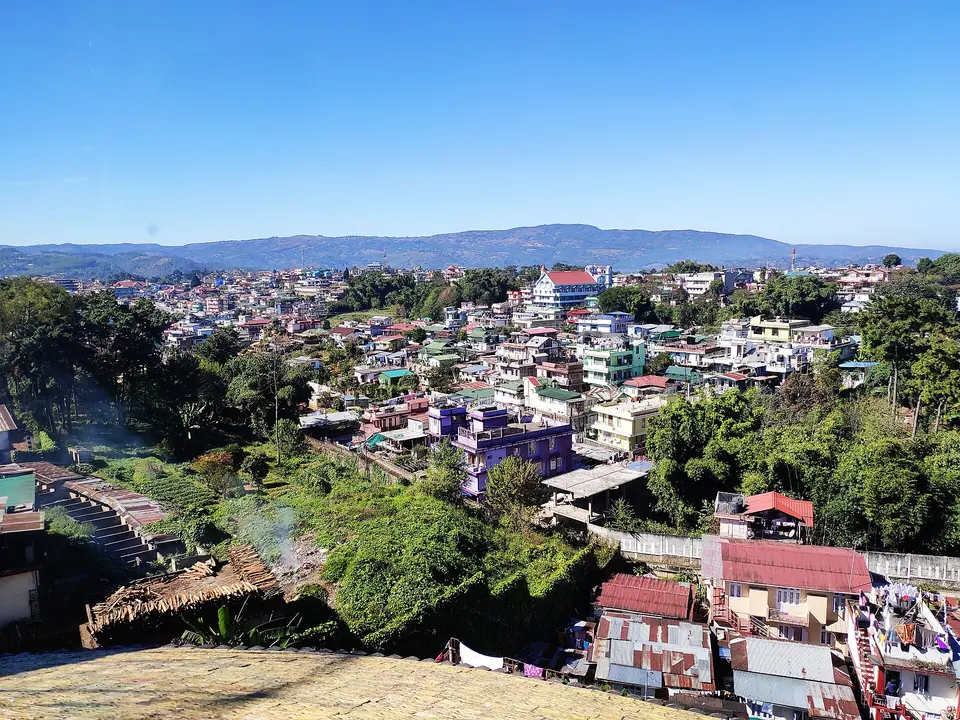

Meghalaya in Monsoon: Rain, Roads and Where to Go
Meghalaya in monsoon, June to September: which falls and treks work, which roads close, Dawki boating rules, a rain-proof route and what to pack.
Shillong Trip Travel Desk · Updated · 10 min read
 JakilDedhia · Commons · CC BY-SA 4.0
Meghalaya in monsoon (June to September) is worth it if you come for waterfalls, cloud and green, and accept slow roads. Base yourself in Shillong and Sohra, drive only in daylight, keep one spare day, and skip Dawki boating and the Kaziranga add-on, which usually stays shut until October. Check current road status before you travel.
Key takeaways
- June and July are the wettest months; Sohra averages about 2,600 mm in each, more than Guwahati gets in a whole year
- Nohkalikai, Seven Sisters and Wei Sawdong are at full flow, but fog can hide them for hours
- Umngot river boating at Dawki is often suspended when the water rises; the river turns green-brown, not glass-clear
- The Shillong–Dawki road was shut near Laitlyngkot from 21 June to 10 August 2026 after a road collapse
- Drive before 3 pm, carry cash and a poncho, and keep one buffer day before your flight
- Kaziranga's safari zones normally close from May to September and reopen in phases in October, so pair Meghalaya with Guwahati instead
On this page 12 sections
- What June to September actually looks like
- Why go in the rain at all
- What works and what doesn't
- Roads, landslides and closures
- Where to base yourself
- Treks and root bridges in the rain
- A rain day in Sohra, hour by hour
- Who should skip the monsoon
- Driving and road manners in the wet
- Festivals worth timing
- How we'd plan it
- What to pack for the wet season
- FAQs
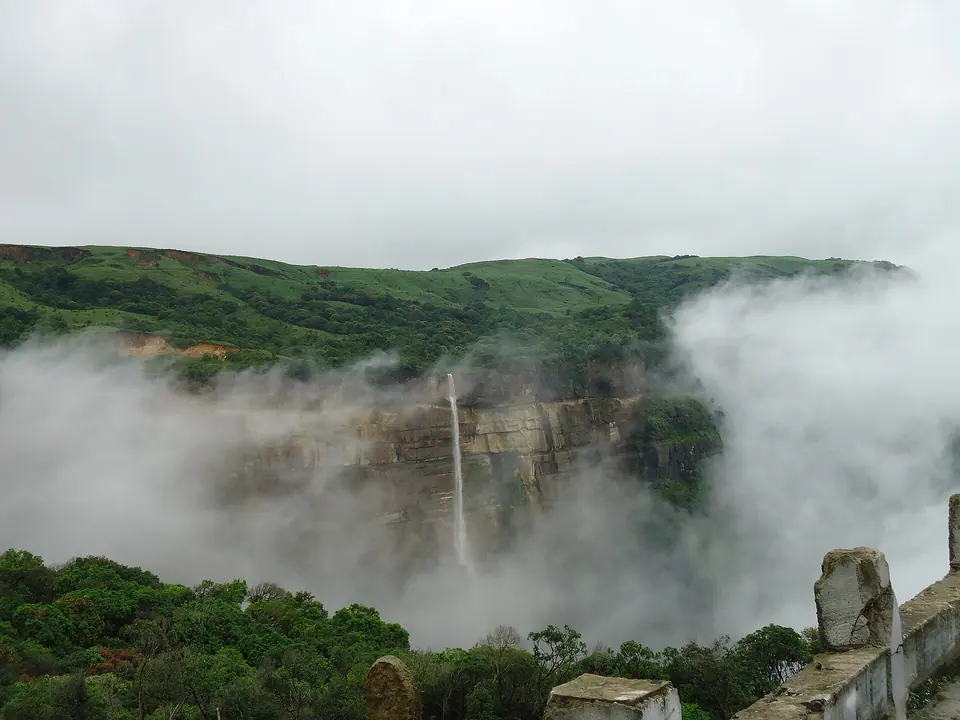
The rain in Sohra does not fall; it arrives sideways, in sheets, for forty minutes, and then the cloud lifts and 300 metres of waterfall appear out of nothing. That is the trade you make in the Meghalaya monsoon. We run trips through these months every year, and this is how we plan them.
What June to September actually looks like
The southwest monsoon usually reaches Meghalaya in late May or early June and eases through September. The southern edge of the Khasi Hills, where Sohra and Mawsynram sit, catches the moisture coming off the Bangladesh plains first, which is why these two towns trade the title of wettest place on earth.
Shillong, 55 km north and at about 1,500 metres, gets far less. It is often drizzly and grey rather than drenched, with days around 20–24 °C and nights that need a light fleece.
| Month | Sohra rain (avg.) | Shillong rain (avg.) | What it means for you |
|---|---|---|---|
| June | about 2,610 mm | about 420 mm | Peak falls, heaviest fog, most landslides |
| July | about 2,670 mm | about 400 mm | Similar to June; festivals in Jaintia Hills |
| August | about 1,770 mm | about 330 mm | Falls still full, slightly more sightseeing time |
| September | about 1,090 mm | about 270 mm | Best monsoon month; roads mostly repaired |
The figures are IMD long-term averages for 1991–2020, rounded, not forecasts. For scale, Guwahati gets about 1,700 mm in an entire year. A single day at Mawsynram or Sohra can bring 400–500 mm, and a dry spell of three or four days is also normal. Look at the IMD district forecast three days out and again the evening before each long drive.
Why go in the rain at all
Three reasons keep bringing people back in these months.
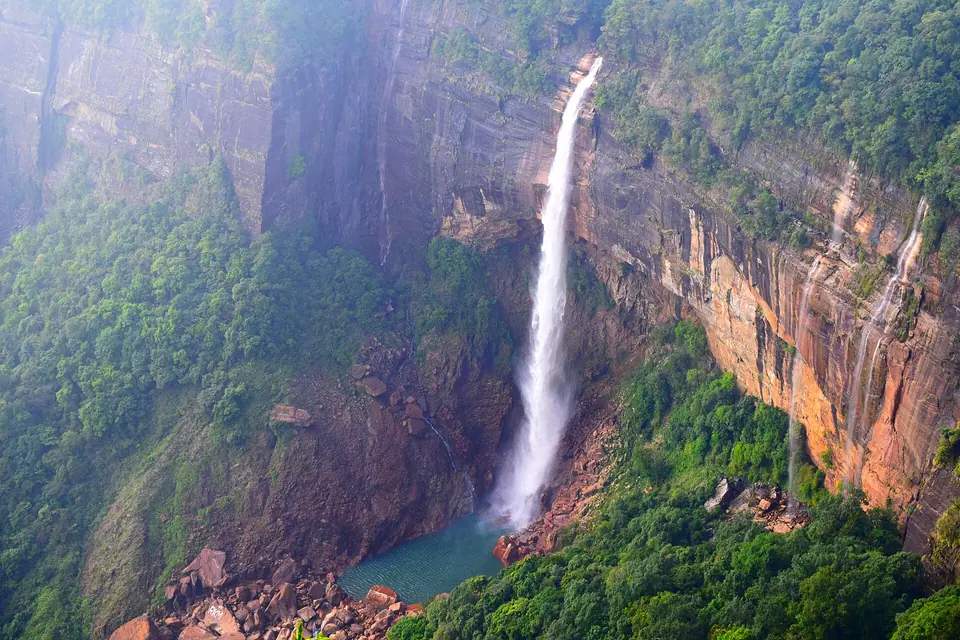
- Waterfalls at full volume. Nohkalikai Falls drops about 340 metres into a green pool; in January it can thin to a thread, in July it roars. Seven Sisters Falls near Mawsmai only really runs as seven streams in the wet months. Wei Sawdong fills all three of its tiers.
- Cloud you can walk into. At Laitlum and on the Sohra plateau, cloud rolls up the valleys and over the road. You lose views for an hour and then get a clear gorge with light on it.
- Fewer people, easier rooms. The October to December rush is long gone. Most viewpoints are quiet on weekdays and hotels are usually easier to book.
The honest downside: you will lose some views to fog, some hours to roads, and at least one activity to a closure. If your trip hinges on one specific photograph, come in October instead and read our best time to visit Meghalaya guide first.
What works and what doesn't
This is the table we send clients who ask whether a plan will hold up.
| Place or activity | Monsoon verdict | Why |
|---|---|---|
| Nohkalikai, Seven Sisters, Dainthlen falls | Go | Full flow; plan two visits in case of fog |
| Elephant Falls, Shillong | Go | Short steps, railings, close to the city |
| Mawsmai Cave | Usually go | Can close after very heavy rain; check at the gate |
| Double Decker Root Bridge trek | Go with care | Slippery steps, leeches, swollen streams |
| Laitlum Canyons | Early morning only | Fog often closes in by late morning |
| Umiam Lake | Go | Lake is full; water sports depend on weather |
| Dawki and Shnongpdeng boating | Often suspended | Fast, silty river; not the clear-water look |
| Krang Suri Falls swimming | Usually closed | Pool is unsafe at high flow; viewing is fine |
| Kaziranga safari | Closed | Park normally shuts May to September |
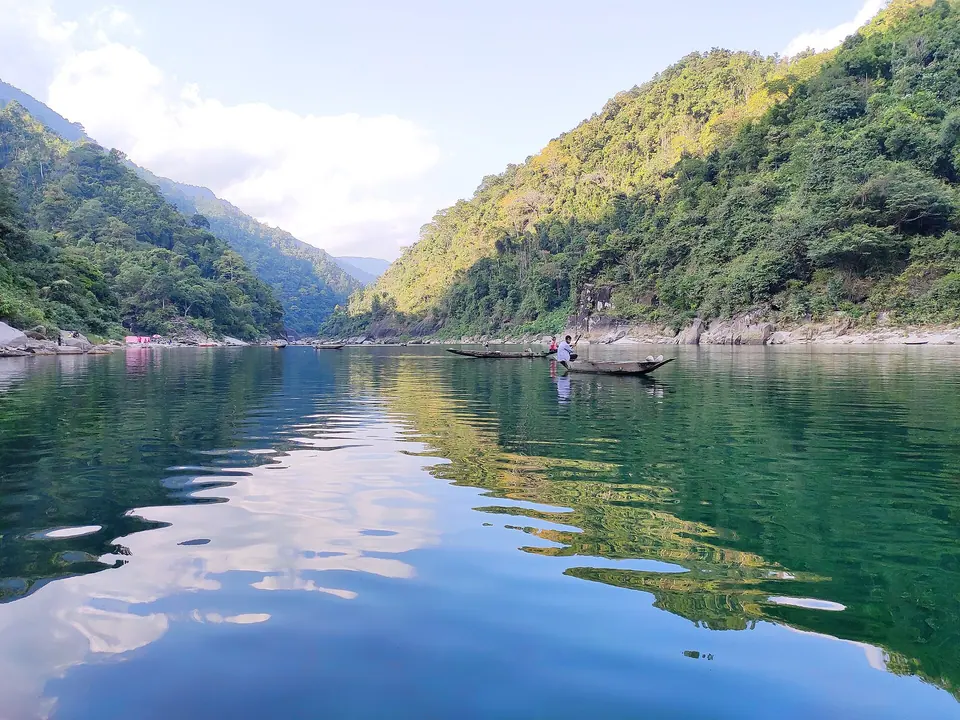
The biggest disappointment we see is Dawki and the Umngot River. Photos of boats floating on glass are taken between November and April. From June the Umngot runs high and brown, and when the current is dangerous the boats simply stop. Go if you are passing, but do not build a day around it.
Roads, landslides and closures
The four-lane highway from Guwahati to Shillong (about 100 km, 3 hours) is the best road in the state and rarely shuts for long. The narrower roads beyond Shillong are where monsoon delays happen.
Two recent examples show the pattern:
- Shillong–Dawki road, 2026. On 21 June 2026, a section near Laitlyngkot in East Khasi Hills collapsed into a gorge after very heavy rain. The district shut the road to all traffic and diverted vehicles via Shillong–Sohra–Sohbar–Dawki or Shillong–Jowai–Amlarem–Dawki. After work on a new structure at Laitlyngkot, the stretch reopened on 10 August 2026, and timed closures for construction had been in force at various points before that.
- Shillong–Sohra road, 2025. In late May 2025, landslides along the 11th Mile–Umtyngar stretch led the district to ask people to avoid travelling to Sohra for a period.
Neither story means the region is off limits. They mean you should plan like a local:
- Drive early. Leave by 7–8 am and be at your hotel by 3 pm. Fog on the Sohra plateau thickens in the afternoon and visibility can drop to 10–20 metres.
- Never drive in the dark in heavy rain. Slips often happen overnight and crews clear them in the morning.
- Keep a buffer day before your flight. Stay your last night in Shillong or Guwahati, not Sohra.
- Carry cash. Card machines and ATMs fail in storms; keep ₹3,000–5,000 per person.
- Follow closure orders. When a deputy commissioner shuts a road or a falls viewpoint, it is for a reason.
Road status changes week to week in this season. Check current status before you travel, and ask your driver the morning of each drive.
Where to base yourself
We use two bases for almost every monsoon trip.
Shillong for arrival, departure and the city: cafés, Ward's Lake, Don Bosco Museum, Shillong Peak on a clear morning, Elephant Falls and an evening at Umiam Lake on the way in. It has the widest range of hotels, reliable power backup and restaurants open late.
Sohra for the falls and root bridges. Two nights here instead of a day trip is the single best monsoon decision you can make, because it gives you two chances at each view. Stay in or near Sohra town, Laitkynsew or the Mawsmai side so viewpoints are 10–20 minutes away.
If you want to see the rain gauge record for yourself, Mawsynram is about 55–60 km from Shillong on a separate road. The draw is the rainfall itself and Mawjymbuin Cave with its stalagmite; it works as a half-day from Shillong on a lighter-rain day.
Treks and root bridges in the rain
The Nongriat root bridges are at their greenest in August and September, and the double-decker bridge with the stream running hard beneath it is worth the effort. It is still a stair-climb: roughly 3,000 or more steps down from Tyrna and the same back up, about 2–3 hours each way for a reasonably fit adult.
In the monsoon we tell guests:
- Start before 8 am so you are climbing out before afternoon storms.
- Wear shoes with lugged soles or sports sandals with straps; flip-flops are a sprain waiting to happen.
- Carry salt or wear leech socks for the forest sections.
- Stay out of the natural pools when streams are brown and fast.
- Stay a night in Nongriat village if you are slow on stairs; guesthouses are basic.
Our Double Decker Root Bridge trek guide covers the route step by step.
A rain day in Sohra, hour by hour
Guests often ask what they actually do when it pours all day. This is a typical wet day from one of our Sohra stays:
- 6:30 am. The cloud is often thinnest at first light. Drive 10–15 minutes to Nohkalikai and give it half an hour.
- 8:30 am. Breakfast back at the hotel while the next band of rain passes.
- 10:00 am. Mawsmai Cave, which is dry inside and takes 20–30 minutes, then the Seven Sisters viewpoint on the same road.
- 12:30 pm. Lunch in Sohra town: rice, dal and a pork or chicken curry at a local eatery costs a fraction of a hotel meal.
- 2:00 pm. Eco Park or the Thangkharang side if the cloud has lifted; otherwise back to the room with tea and a book.
- 4:30 pm. Second look at whichever viewpoint was fogged in the morning. Short breaks in the cloud are common late in the day.
The rhythm is simple: short outings, a dry base 10 minutes away, and no fixed timetable. That is why we insist on two nights in Sohra.
Who should skip the monsoon
The rain months are not for every traveller, and we would rather say so up front.
- Travellers with only three days and a fixed flight. One closed road can eat a third of the trip.
- People who dislike stairs on wet stone. Many viewpoints involve 50–300 steps, and the root bridge trek involves thousands.
- Anyone set on clear-water boating at Dawki. That is a winter and spring experience.
- Wildlife-first trips. Kaziranga, Manas and most Assam parks are closed or restricted. See Kaziranga's best time before you combine states.
- Senior travellers with mobility concerns. A monsoon trip can still work, but only with a slower pace and a car that can drop you close to each viewpoint.
For these groups, October and November give green hills, full-ish falls and clearing skies with far fewer hold-ups.
Driving and road manners in the wet
Most monsoon trouble on Meghalaya roads comes from rushing, not from the rain itself. The drivers we work with follow a few rules worth knowing, so you can tell a careful driver from a rushed one. (Self-drive rentals for tourists have been prohibited in Meghalaya since June 2025, so you will be in a car with a local driver.)
- Headlights and fog lamps on through the Sohra plateau, even at noon.
- No overtaking on blind bends; trucks use the full road on the Dawki and Jowai routes.
- Pull over and wait if visibility drops below 20 metres. Fog on the plateau usually moves within 15–30 minutes.
- Watch for small stones on the road surface. They are the first sign of a slope moving.
- Fill fuel in Shillong. Pumps beyond the city are fewer and can run dry after supply disruptions.
If your driver says a road is not worth it today, take the advice. They hear about slips on local WhatsApp groups long before any news site does.
Festivals worth timing
Behdienkhlam, the best-known Pnar festival of the Jaintia Hills, is held in Jowai each monsoon, usually in July, with processions carrying tall decorated structures and a mock contest in a muddy pool. Dates follow the local calendar and are set each year, so check current status before you travel. Our Jaintia Hills trip via Jowai, Krang Suri and Nartiang can be timed around it.
How we'd plan it
For a first monsoon trip, four nights is the minimum that absorbs one bad day.
| Day | Plan | Overnight |
|---|---|---|
| 1 | Guwahati to Shillong (100 km, 3 hours), Umiam Lake stop, evening in the city | Shillong |
| 2 | Early to Sohra (55 km, 1.5–2 hours): Nohkalikai, Mawsmai Cave, Seven Sisters | Sohra |
| 3 | Root bridge trek from Tyrna, or Wei Sawdong and Dainthlen if the stairs don't suit | Sohra |
| 4 | Second look at Nohkalikai at dawn, Laitlum or Mawsynram, back to Shillong | Shillong |
| 5 | Shillong to Guwahati Airport, leaving by 9 am | — |
This is close to our Monsoon Meghalaya trip with Sohra, Mawsynram and Nohkalikai. If you only have a long weekend, the three-night Shillong and Cherrapunji plan covers the main falls with one night in Sohra.
Photographers who want time to wait out the fog should look at the five-night Meghalaya photography tour, which builds in sunrise slots at Laitlum and Nohkalikai. With six nights, the Complete Meghalaya route adds Mawlynnong and Krang Suri; in the monsoon we swap the Dawki boat ride for a longer village walk.
What we leave out in these months: Kaziranga (closed), Dawki boating as a must-do, and anything that needs a 4 am drive on wet hill roads.
What to pack for the wet season
Pack light but wet-proof. The essentials:
- Rain jacket with a hood, or a long poncho that covers a daypack
- Compact umbrella for town days
- Two pairs of shoes with grip, so one can dry
- Quick-dry trousers and T-shirts; no jeans
- Light fleece for Shillong evenings
- Dry bags or zip pouches for phone, cash and ID
- Power bank; storms cut power for an hour or two
- Salt or leech socks if you are trekking
- Basic medicines, including something for stomach upsets and a small antiseptic
Our full packing list for the Northeast covers other seasons and Arunachal's altitude.
Want a monsoon route checked against this week's road reports? Talk to our travel desk.