
Best Time to Visit Kaziranga: Month by Month Guide
Best time to visit Kaziranga: season dates, month-by-month sightings, weather, fog and crowds, which range to pick when, and what to do when the park is shut.
Shillong Trip Travel Desk · Updated · 9 min read
 Anupom sarmah · Commons · CC BY-SA 4.0
The best time to visit Kaziranga is February to April, when the tall grass has been burnt back and rhinos, elephants and buffalo are easiest to see. November to January is cooler and best for migratory birds, but mornings are foggy. The park usually opens in phases from October and closes for the monsoon around May.
Key takeaways
- Kaziranga opens in phases each autumn and closes for the monsoon around May. In 2025 the Bagori circuit reopened on 26 September, Kohora in mid-October and elephant rides on 1 November.
- February and March are our top months: burnt grass means open views, days sit around 24–28°C and animals come out to the water.
- December and January bring the most migratory birds and the coldest mornings, often 7–10°C with fog until about 8–9 am.
- October and early November are green and quiet, but the elephant grass stands several metres tall and hides animals.
- From May to September the main ranges close; July and August floods can cover large parts of the western park.
- Christmas to New Year and long weekends are the busiest days; book jeep safaris and lodges 4–6 weeks ahead for those dates.
On this page 15 sections
- The season in one paragraph
- Month by month
- October and November: green and quiet
- December and January: birds, fog and crowds
- February and March: our pick
- April: hot, but rewarding
- May to September: when the park is shut
- Which range to choose when
- Safari timing through the season
- What it costs, whatever the month
- Weather and what to wear by month
- Photography by season
- Combining Kaziranga with other parks
- Getting there in each season
- How we'd plan it
- FAQs
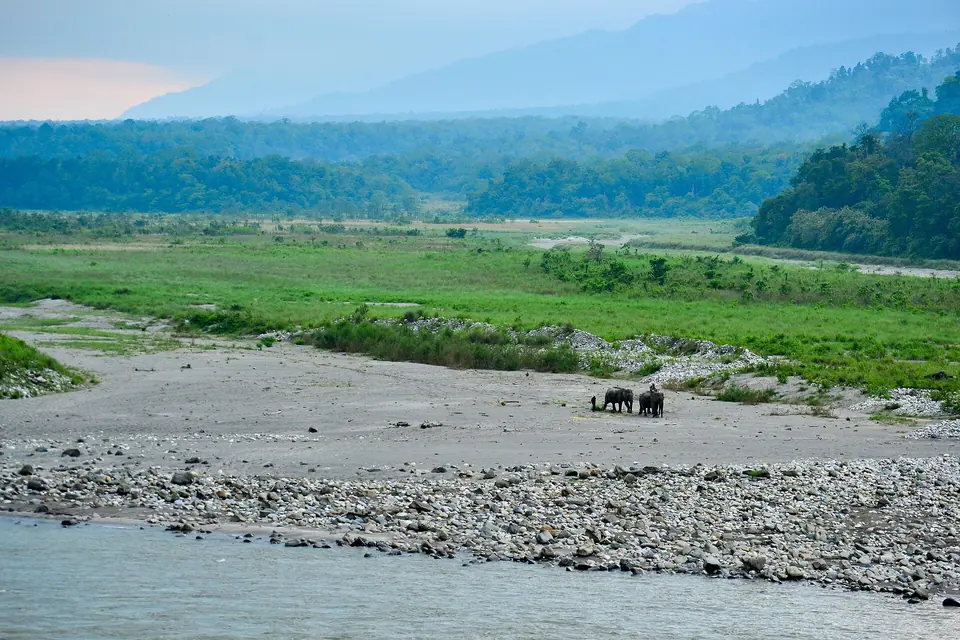
The same stretch of Kaziranga's Central range can look like two different parks. In early November, you drive between walls of elephant grass taller than the jeep and count yourself lucky to see a rhino's back. In early March, after the burning, the same track opens onto a plain where you can count 20 rhinos, a herd of wild buffalo and a line of elephants crossing a beel, all in one view.
That is why the question of when to go matters so much here. We have waited at the Kohora gate at 7 am in every month the park is open, and this is our honest month-by-month view.
The season in one paragraph
Kaziranga is a floodplain park on the south bank of the Brahmaputra, about 1,090 km² at its core, and a UNESCO World Heritage Site since 1985. It floods every monsoon, so safaris run only in the dry season: usually from October, in phases, until the park closes around May. The 2022 census counted 2,613 greater one-horned rhinos, the largest population anywhere, and you will almost certainly see them in any open month. What changes through the season is the grass, the weather, the birds and the crowds.
Check current status before you travel, because opening dates depend on flood damage to roads each year.
Month by month
| Month | Park status | Grass | Weather (day / early morning) | Best for | Watch out for |
|---|---|---|---|---|---|
| October | Partial, from early October in recent seasons | Very tall | 30°C / 22°C | Quiet, green landscapes | Short routes, hidden animals |
| November | Fully open | Tall | 27°C / 15°C | Early birds, comfortable days | Grass still high |
| December | Open | Burning begins | 24°C / 9°C | Migratory birds | Fog, holiday crowds |
| January | Open | Burning | 23°C / 8°C | Birds, cool days | Fog until 8–9 am |
| February | Open | Short, burnt | 26°C / 11°C | All-round sightings | Busy weekends |
| March | Open | Short, fresh shoots | 29°C / 15°C | Best visibility, tigers at water | Warming afternoons |
| April | Open; closing date set each year | Short to new growth | 32°C / 20°C | Animals at water bodies | Heat, pre-monsoon storms |
| May–Sept | Closing in May, then shut | Monsoon growth | 32°C+ humid | Tea, orchid park, villages | Floods July–August |
Temperatures are typical ranges, not forecasts.
October and November: green and quiet
After the monsoon, the park reopens in stages. In 2025, a limited circuit in the Western (Bagori) range reopened on 26 September ahead of Durga Puja, the Central (Kohora) range followed in the second week of October, and elephant rides resumed on 1 November. In late September 2026, the forest department expected to reopen in October, with road repairs in the Western and Burapahar ranges slowed by standing water.
What you get: a vivid green park, few visitors and pleasant evenings. What you give up: visibility. The elephant grass stands several metres high, so you see animals mainly at clearings and water. Rhinos are still likely; elephants and buffalo depend on luck.
November is a good compromise, especially in the second half, and it pairs well with Meghalaya, where the rain has stopped and the waterfalls are still full. Our Shillong, Cherrapunji and Kaziranga trip works best from mid-November.
December and January: birds, fog and crowds
These are the coldest months, and the most popular with Indian families on winter holidays.
- Birds: migratory waterfowl and waders arrive from around November and peak in December and January. The Eastern range at Agaratoli, with its wetlands, is the one for birders.
- Burning: the forest department begins controlled burning of the grass around this time, which starts opening up views.
- Fog: mornings are often foggy until 8–9 am. The first elephant ride and first jeep slot can be grey and cold.
- Crowds: the week from Christmas to New Year is the busiest of the year. Jeep slots and lodges sell out; book 4–6 weeks ahead.
In these months, we often put guests on the afternoon jeep slot as their main safari. Sunset comes around 4:30 pm, so afternoon safaris are short, but the light is clear. Our Northeast in Winter route combines Kaziranga with snow at Sela and Tawang.
February and March: our pick
If you can choose any dates, choose these. By February most of the grass has been burnt back, fresh green shoots draw grazers into the open, and animals are visible across long distances. Days are warm, mornings are crisp rather than cold, and fog is much rarer.
March is the month we most often see big herds of wild buffalo, elephants with calves, swamp deer (barasingha) and hog deer in the open grassland. Tigers also visit water bodies more as it warms, which improves the small chance of a sighting. Kaziranga became a tiger reserve in 2006 and has one of the highest tiger densities in India, but the grass still hides most of them.
Weekends in February can be busy, especially around school holidays. Weekdays are calmer.
April: hot, but rewarding
April is usually the last full month of the season. Afternoons reach 32°C or more, and pre-monsoon thunderstorms can roll in after 3 pm. The upside: animals concentrate around the remaining beels and are easy to find, and the park is quieter than in February and March.
Take the first morning jeep slot and rest through the afternoon. Mid-April also brings Rongali Bihu, Assam's spring festival, which is a good reason to add a day in Guwahati or Jorhat.
May to September: when the park is shut
Around May, the park closes for the monsoon. The monsoon arrives in June, and in July and August the Brahmaputra floods large parts of the park; in the western areas, most of the land can go under water. Animals move to raised highlands built inside the park and to the Karbi Anglong hills to the south, crossing the national highway along known corridors. Speed limits on the highway are enforced during floods.
You can still visit the area. The orchid and biodiversity park at Kohora, tea estates and village walks are all possible, and animals are sometimes seen from the highway. But it is not a safari trip, and we tell guests so plainly. Check current status before you travel.
Which range to choose when
Kaziranga has four main tourist ranges, and each has a season when it shines.
| Range | Gate | Best months | Why |
|---|---|---|---|
| Central (Kohora) | Kohora | November to April | Most reliable rhinos, elephants, buffalo |
| Western (Bagori) | Bagori | February to April | Highest rhino density in open grass |
| Eastern (Agaratoli) | Agaratoli | December to February | Wetlands and migratory birds |
| Burapahar | Ghorakati | February to April | Quieter, hill forest edges, primates |
For a two-night stay, we book Central and Western in the dry months, and swap one for Eastern in winter if birds matter. Our Kaziranga safari guide explains booking, slots and fees.
Safari timing through the season
Jeep safaris run in a morning slot and an afternoon slot in all four ranges. Elephant rides run only in the Central (Kohora) and Western (Bagori) ranges, at dawn. Typical timings in recent seasons:
- Elephant ride: roughly 5:30–7:30 am, in one-hour batches
- Morning jeep: from about 7:30 am, with about 2 hours on the track
- Afternoon jeep: from about 1:30 pm, finishing between 3:30 and 5 pm depending on sunset
Slots shift with daylight: earlier in March and April, later in December and January. In December and January, choose the second elephant batch rather than the first, because fog and a late sunrise make the first one dim. There is no night safari at Kaziranga. Timings change each season, so check current status before you travel.
What it costs, whatever the month
Kaziranga's fees do not change by season, but availability does. As of 2026:
| Item | Indian adult | Foreign adult |
|---|---|---|
| Park entry | INR 100 | INR 650 |
| Still camera | INR 100 | INR 200 |
| Jeep safari, per vehicle up to 6 | From about INR 3,500 | Higher foreigner rate |
| Elephant ride, per seat | Roughly INR 1,200–2,000 | Higher foreigner rate |
Jeep prices include the road toll, driver and guide, and vary with range and operator. Mobile phones are free to use. Elephant seats are limited and go first in December and February, so book them as soon as your dates are fixed. Fees change, so check current status before you travel.
Weather and what to wear by month
Kaziranga sits at low altitude on the plains, so it is warmer than Shillong or Tawang, but open jeeps at dawn are cold in winter.
- November and February: a fleece and a light jacket for the morning, T-shirt by noon.
- December and January: thermals, a warm jacket, gloves and a cap for the elephant ride and first jeep. Mornings drop to about 8–10°C, and the wind in an open jeep makes it feel colder.
- March: a light layer at dawn, then cotton. Sunscreen and a hat for the afternoon.
- April: breathable cotton, a hat, and a rain jacket for late-afternoon storms.
- All months: neutral colours such as olive, khaki and brown; avoid bright white and red. Carry a scarf or buff for the dust on dry tracks.
Photography by season
Photographers should pick their month for the light and the grass as much as for the animals.
- November: clean, rain-washed air and green backdrops, but animals are often partly hidden.
- December and January: soft, misty mornings that can look beautiful once the fog lifts. Shoot the afternoon slot for clear light.
- February and March: the best for open compositions of rhinos, buffalo and elephants against short grass, with raptors on bare trees.
- April: heat haze by mid-morning. Shoot early and use the water bodies.
A 100–400 mm lens covers most situations from the jeep. Tripods are impractical in a jeep; a bean bag on the door frame works better.
Combining Kaziranga with other parks
If your dates fall at an awkward point in Kaziranga's season, the Assam parks around it can fill the gap.
- Pobitora Wildlife Sanctuary, about an hour from Guwahati, has a dense rhino population in a small area and suits a first or last day.
- Manas National Park, on the Bhutan border, is wilder and suits November to April.
- Nameri National Park, near Tezpur, is known for birding and river rafting in the cooler months.
Our Kaziranga, Manas and Pobitora trip covers three parks in six nights, and the Kaziranga and Nameri Birding route is built for December to February.
Getting there in each season
Kaziranga is about 200 km from Guwahati, a drive of 4.5–5 hours on the national highway. Jorhat airport is about 90–100 km east and suits guests flying in from Kolkata or Delhi. In winter, allow extra time for fog in the early morning; in April, afternoon storms can slow the road.
How we'd plan it
For a first visit, this is what we suggest:
- Pick February or March if your dates are open. If you want birds, pick December or January and accept the fog.
- Stay two nights at the Kohora end of Kaziranga National Park, close to the Central range gate.
- Book three safaris: Central morning, Western morning and one afternoon slot, plus an elephant ride if available.
- Avoid Christmas to New Year unless you book 4–6 weeks ahead.
That is exactly what our Kaziranga Safari Break delivers, and our Guwahati and Kaziranga trip adds the Kamakhya Temple and a Brahmaputra evening. For a full day-by-day, see Kaziranga in 2 days, and for lodges, best resorts in Kaziranga.
Tell us your dates on our contact page and we will tell you which ranges will be open and which slots to book.